Friday, October 25, 2013

The Epistemology of the Chamber Pot

I had high hopes for Ari Folman's new movie "The Congress" (2013).  I liked Folman's previous movie "Waltz with Bashir" (2008) and I love the novel his latest movie is ostensibly based upon: Stanislaw Lem's The Futurological Congress (1973).
 
When I realized that in California you could not see "The Congress" for love or money, my hopes were raised even higher. Surely, I thought, it is going to be an underground masterpiece, a brave challenge to the mindless Hollywood pablum, an Israeli ticket to the international SF Hall of Fame. I suspect the director thought the same.

Of course, the higher up you are, the further down you fall. "The Congress" is a great idea gone awry; or rather, a couple of ideas pulling in different directions and ending up in a mess. It is almost as if Folman fell victim to the syndrome described in his source novel: ontological confusion. Lem's hero does not know what "movie" he is in, and neither, it seems, does Folman.

Lem's delightful satire describes the adventures of hapless Ion Tichy who is invited to a futurological congress where chemical means of manipulating reality perceptions are being tested. Having clashed with a would-be papal assassin, played cards with rats, and repeatedly fallen into the sewer, Tichy is frozen and wakes up in the utopian future where all desires are satisfied by taking little pills that enable you to experience whatever you want to experience, and be whoever you want to be. Whether you scale Everest, play violin, or sleep with the most beautiful woman in the world - any experience is ultimately translated into the chemicals sloshing in the brain. And it is easier to tweak neurotransmitters than to do all the tiresome things involved in changing the physical world.

But the problem with virtual reality is that it is never virtual enough. Somebody has to make those little pills that give us paradise; somebody has to wash, and clean, and empty the chamber pots of the happy sleepers. At the end of the novel Tichy confronts the rulers of the chemical utopia who push their drugs on the increasingly sick and deprived population, while enjoying real food and real sex.

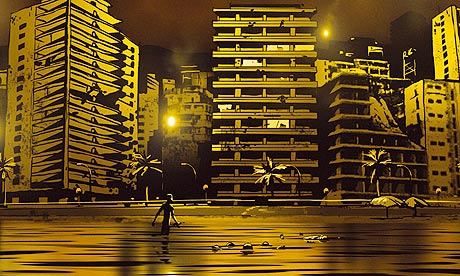
Folman's movie has a very different story which adds "human interest" on top of political satire.The first part deals with the travails of the aging actress Robin Wright who is "scanned" into the computer and put out to pasture.The opposition is clear: human complexity versus artificial simplicity; nature versus imitation; reality versus illusion. The first part employs flesh-and-blood actors, and Robin's aging but still beautiful face dominates the screen.

In the second, animated, part Robin is invited to a futurological congress where she acts the part of Tichy, enmeshed in layers of hallucinations and unable to discern what, if anything, is real. She wakes up twenty years later into a chemical paradise where she searches for her sick son.

But what is wrong with the simulacrum? Why are we to identify with Robin's desire not to become an image or with her impassioned speech that  decries the manipulation of reality by corporations? Why is nature better than civilization?

There are two answers to it: one given by Rousseau and one by Marx. Rousseau's answer is that nature is better by definition. Marx's answer is that civilization is better but you have to grapple with nature to produce civilization - and people who do the grappling are unable to enjoy the fruits of their labor.

This is Lem's point in the original Futurological Congress. Virtual reality is a mere sop given to the poor whose labor is exploited and whose bodies are ruined. Simulacrum is not evil in itself but only insofar as it blinds people to the reality of their situation.

Folman's movie seems to come close to this position, especially in the striking images of the filthy, sick, deranged masses that Robin encounters when she takes an antidote to the hallucinogens. But then the movie quickly changes course and has Robin go back into the chemical utopia where she can find her son - or a simulacrum of thereof. Perhaps the ending is supposed to be a paean to maternal love. But to me it just felt disappointing and incoherent. Folman started with a critique of Hollywood as the drug-pusher of international capitalism. But he ended up with a Hollywood sob story.

As for me, I am with Lem - and yes, with Marx. I would love to be scanned into a computer and to enjoy the freedom of virtual reality. I'd love to live in an animated utopia where smiling babies grow on rose-bushes. But in our world, somebody has to change the diapers.


Friday, July 5, 2013

Zombies on the march

So here are your zombies: an unstoppable human wave, climbing walls, sweeping over firing soldiers, overturning cars, smashing everything in its path. Blind, deaf, pitiless, faceless - and all powerful.

Saint Petersburg 1917. Paris 1968. Cairo 2013.

And Brad Pitt saving his sniveling family from the horror of the masses and presumably bringing it back to the suburban paradise, complete with pancake breakfasts and picket fences.

"World War Z" is a bad movie: not just because it is incoherent but because it is false in its message. It is telling its viewers that the huge crowds and flash mobs they are seeing daily on their screens can be contained by individual heroism and stockpiling of guns: a Tea Party ideology in the age of global movements. Max Brooks' "World War Z" tried to revive the spirit of communal action by looking back to World War 2. The form of the book, with its many individual voices telling a common story, is a pastiche of Stud Terkel's "The Good War". It may be preposterous in its premise and naive in its depiction of individual countries' politics (Israel's going to bring all the Palestinians into its shelter? Really?) but it is responding to the real challenges of       globalism. "World War Z" the movie is hiding its head in the sand and hoping the revolution will pass it by.

The zombie, like all pop-culture monsters, is a metaphor for our fears. Like all such monsters, it is polysemic. It may represent the fear of the body, the fear of death, even, as I argued in my recent article, the fear of language.
http://www.tijdschriftframe.nl/portfolio/item/frame-26-1-apocalypse-in-contemporary-culture/

But the movie is quite clear in what fears in invokes. The opening (and visually most impressive) shots are of huge crowds, multitudes, people-choked giant cities. Small-town America looking at the world and seeing zombies on the march. And small-town America is right: the zombies are coming. I, for one, hope they'll get here soon.


Tuesday, April 16, 2013

Maya Kaganskaya

Today is the second anniversary of my mother's death. I don't believe in commemorative dates. Memory has no calendar; it comes and goes as it wills. Like writing, memory is free; like writing, it stays with us, sometimes receding into the background and sometimes coming back at unexpected moments as a flash of illumination or a stab of longing. My mother's writing is alive today, somewhere in the world. And so is my memory of her.    

Thursday, April 4, 2013

Jewish Storytelling


Last month, a conference on Jewish storytelling took place at Stanford University (http://www.stanford.edu/dept/jewishstudies/events/storytelling_conf/index.html). Unexpectedly there was a lot of talk about science fiction and fantasy: a discussion of contemporary Israeli fantasy by Danielle Gurevitch and Vered Shemtov, Samantha Baskind’s lecture on Jewish graphic novels, my own talk about Jews in/as SF and so on. This is different from similar gatherings a couple of years ago when the discussion would be safely confined to the American-Jewish realistic canon of Saul Bellow, Philip Roth etc.
But while the boundaries of genre were breached, the boundaries of ethnicity were not. Most talks took the “Jewishness” of the texts discussed for granted, either because they were written by self-identifying Jews or because of the topic, such as the Bible. For example, the scriptwriter Michael Green talked about his adaptation of the Biblical Book of Kings for TV (the series failed but the talk was quite interesting).
But if anything written by a Jew belongs to “Jewish” literature by definition, we risk instituting a sort of literary Nuremberg laws, roping into our enclosure a lot of people who have no interest in being in. Stanislaw Lem was born a Jew and in fact barely escaped the Holocaust but he was raised Catholic, wrote in Polish, and did not think of himself as Jewish. On the other hand, Isaac Asimov self-identified as a Jew and spoke Yiddish but had little to say about Jewish history or tradition.
So how about the topic? The Bible is a Jewish scripture but for millions of Christians who were the intended audience of Green’s TV series Kings, it is now their book. If we take the Holocaust as the defining historical experience of Jewry in modern times, many great Holocaust books were not written by Jews. Philip Roth’s The Plot Against America is an alternate history of the Holocaust but so are The Man in the High Castle by Philip Dick and Fatherland by Robert Harris. Roth is Jewish, Dick and Harris are not.
This is the conundrum that bedeviled Jewish literature for many years; but now it increasingly seems to be spreading into literature as a whole. More and more writers write in languages not their own; more and more live and/or publish in countries not of their birth. Both people and stories freely circulate in the borderless online universe.
Still, I do not think that it means we can abolish all national designations and speak of “global” literature. Doing so would blur the real issues of economic inequality, historical heritage and political power. Words may have no country but people do.
So perhaps conferences like the one at Stanford would do better to shift emphasis from the adjective (“Jewish”) to the noun (“storytelling”). Maybe the point is precisely that some genres, such as SF, are better at dealing with issues of homelessness, alienation, historical injustice and rapid change overtaking our world. Maybe the point is not that there is Jewish SF but rather than all SF is, in some sense, Jewish.     

Wednesday, November 14, 2012

M for Mummy

Now we know what M in the James Bond franchise stands for. Mummy, of course.

For those who have not yet seen the latest James Bond movie "Skyfall", it is highly recommended. It manages to be tongue-in-cheek without being cutesy; nostalgic without being soppy; and action-oriented without wasting an entire arsenal of ordnance. The visuals are great: Daniel Craig is good-looking in a craggy, unshaven sort of way; and the plot (almost) makes sense.

But the greatest achievement of the movie as far as I'm concerned is to rewrite the foundation of Western civilization: the Oedipal myth. Until now, the conflict between fathers and sons has been central to our most exalted narratives (see Hamlet and Star Wars). If you believe Harold Bloom (I don't), the father-son relationship underlies the dynamics of literary creativity (see The Anxiety of Influence). And yet James Bond has as little regard for Dr. Freud as he had for Dr. No.

The plot of the movie (spoilers alert!) hinges on the fact that Bond's boss, M (superbly played by Judy Dench,) has betrayed an agent named Silva to the nefarious Chinese.

(Incidentally, here is the link to a hilarious article on the Chinese reaction to this:
http://www.scmp.com/business/article/1080685/will-james-bond-bow-beijings-censorship).

The agent comes to extract revenge and is defeated by Bond, who holds the mortally wounded M as she lies dying. No romance here: M is an old lady. But it is very clear that her relationship with Silva and Bond is the relationship between a stern mother and two sons who compete for her affection and approval. Silva is practically hysterical, begging M to kill both of them because, of course, matricide is the ultimate tabu. Bond is less emotional but more dutiful, which is why he becomes M's heir designate, continuing her work on behalf of Queen and country. There is no ghost of the father haunting this movie: authority and power are represented by a mother figure. It is as if Hamlet contested the crown with Gertrude or Luke Skywalker crossed swords with Mrs. Darth Vader.

What difference does it make? Very little, in my opinion. Power is power, whether wielded by a man or a woman. Family romance does not go very far in describing the dynamics of social hierarchies. But in the light of the latest soap opera unfolding in the CIA, with General David Petraeus brought down by a silly affair with his biographer, perhaps we could use some more of M's no-nonsense, I-told-you-to-clean-your-room maternal authority.   

Monday, July 16, 2012


My last thoughts on the sad plight of American cities - and the promised solution.

The modernist utopia of the city as a machine for living (Le Corbusier) is gone, together with the rest of modernist utopias: Communism, fascism, Nazism. I can recommend an excellent book by Mark Mazower "Dark Continent: Europe's Twentieth Century" which describes the utopian tide that swept over the West in the aftermath of the butchery that was World War One - and its result in the even greater butchery of World War Two. So I will not mourn the loss of Detroit as a Fordian model for the future city, in which disciplined armies of uniformed workers produced uniform Models T for the uniformly happy citizens.

On the other hand, the deadly boredom of the suburbia is unsustainable, both economically and socially. I'm sick of seeing empty streets, occasionally relieved by a waddling figure of gargantuan proportions (this is, if the street even has a sidewalk).

So here is my own utopian solution. Bring in those "hungry multitudes" of Mexicans, Indians and Chinese who still believe in the American Dream abandoned by most Americans. Dump them in the ruined heart of Detroit, Oakland, Buffalo NY and similar urban wastelands. Promise them a path to citizenship if after five years they are still living in the city, paying taxes and have opened a small business or found a job. Send them back if they move to suburbia.

It's not going to happen, of course. There is no political will for doing something like this. And am I not contradicting myself, by mocking modernism's social engineering, while indulging in a social engineering of my own?

Very well, so I contradict myself, as Walt Whitman said. It is still the only way. Without it, American cities will die, while cities in the rest of the world (especially Asia) will grow and prosper. And cities are not only cultural and economic centers but a way to avoid the ecological catastrophe of cancerous growth, unrestrained traffic, and greenhouse-gas pollution.

On the other hand...On a recent visit to Oakland CA, which looks like Detroit's depressed sibling, we suddenly heard a buzz of human voices in the desert of abandoned buildings. We followed the sound...and were engulfed by a crowd of shoppers. They were all Chinese. Oakland's Chinatown on Sunday was so bustling that some dim-sum places had waiting lines. (Oh yes, the mayor of Oakland is Chinese).

"What is the city but the people?" Shakespeare, Coriolanus.            

Sunday, July 1, 2012

Dispatches from Detroit - 2. Who Killed the Big D?

Detroit is one of the most beautiful cities in the world.

I can just imagine the reactions to it. To most people, word associations with Detroit are: crime, decay, bankruptcy, apocalypse (not necessarily in this order). Most people are right, and still I stand by my assertion: Detroit is one of the most beautiful cities in the world.


                                                       Part of the Rivera murals

Yesterday a couple of people from the conference I'm attending (Science Fiction Research Association annual gathering) drove to Detroit Institute of Art. This is a world-class museum, better and bigger than the De Young and Legion of Honor in San Francisco. It has a stunning collection of contemporary art, a great 19th century display (including Whistler, Pissarro and Gauguin), and the jaw-dropping atrium painted with murals by Diego Rivera. The murals show Detroit in the 1930s - the city of the future, with the industrial armies marching boldly into the working-class utopia of glass, skyscrapers and red stars (Rivera was a communist, a fact tactfully avoided by our helpful guide). But no matter: the murals are so stunning that for a moment one feels like belting out "The International". The atrium (newly renovated) should be filled with oohing and aahing crowds - and in San Francisco it would be. This Saturday morning in Detroit a couple of tourists wandered through the giant museum, looking lost and vaguely embarrassed.

Outside the museum, broad avenues of Art Deco high-rises, brownstone mansions and jewel-box churches stretched into the sunlight. The high-rises are abandoned -  vertical ghost-towns. The brownstones are locked up. The churches are burnt. In five blocks, we saw one person - a homeless black shambling through the empty city like an escapee from a zombie invasion.

                                                These skyscrapers are empty

The municipality has dotted the downtown with pretty little parks. I was relieved to see them empty. This morning, one of the participants in my panels described those green places as sites where bodies are dumped. I guess they had been removed earlier.

So what happened? Who killed the Big D? One of my fellow visitors reminded us of the concerted efforts of car companies in the mid-twentieth century to undermine public transportation. There are no more streetcars named desire, and Ford, GM and the rest of them are to blame. There is racism, of course. Segregation is just a word until you see the streets of Detroit where a white face means a visitor. And there is an all-American glorification of small-town life, which has created the nation of overweight gun-toting SUV-drivers. And still, it seems unbelievable  to me that a symbol of national aspirations and a world-class city would be just left to rot. Can you imagine the English walking away from London? The Italians abandoning Rome?

I have no complete answer to this enigma. But do I have a solution for Detroit? You bet. See the next installment.
    

Thursday, June 28, 2012

Dispatches from Detroit - 1. Can One Enjoy a Dead City?

Detroit has an impressive GM center, a new riverside walk, and a spacious downtown, encircled by a light rail called "People Mover." What it does not have is people.

Detroit has become a symbol of the death of American cities. On my first visit here, I am beginning to understand that this death is a more complicated process than I supposed - a slow, gnawing decline rather than an apocalyptic destruction. I came expecting burnt-out streets and gutted buildings. I'm sure there are many such sights in the outer rings of the city but from where I am now - on the 14t-h floor of  a downtown hotel - Detroit looks very grand indeed. The skyscrapers, some in Art Deco style, are somewhat shabby but there is a crystal cluster of the new Renaissance Center by GM to promise new architectural glories. There are small parks, sky-walks, and wide pavements.

And no people. The parks are empty; the glass sky-walks are blazing with sunlight, unobstructed by moving bodies; even the river's placid flow is not marred by boats or cargo ships. The concrete labyrinth of RenCen should be bustling with retail and eateries: similar places in Asia shock you into parting with your money in a myriad colorful ways. A dejected pharmacy, a couple of junk food places, and a single boutique is all you get in this GM showpiece (well, there are also cars on display on the ground floor).

The giant riverside walk which is beautiful enough to make Melbourne is populated by a couple of cyclists and a group of black women in yellow t-shirts pathetically trying to undo the lifetime of junk food consumption by walking. There is a sign "God Bless America" on the terminal for crossing into Canada.

It is people who make a city. And the people are not here. Where are they? In the suburbia? Why? What made Americans give up this great city that for so long was a symbol of American pluck and ingenuity?
Why did they leave behind this beautiful urban corpse? I came expecting a Mad Max urban wasteland and found a sad mausoleum. What makes it even sadder is the fact that it refuses to die. The city fathers are  investing in revitalizing the downtown. Volunteers are organizing bus tours of local businesses. But one cannot have shops without customers; streets without pedestrians; cities without citizens.

The few local faces one sees on the streets are all black. Is this the key? The white escape to the suburbia is a well-documented phenomenon but it is spooky to see it so palpably in action. And still, racism aside, the mystery remains. Segregation is, unfortunately, a well-known urban phenomenon. But why did the affluent whites abandon the beauty and grandeur of the city center to the impoverished blacks? This is the opposite of what is happening in many European cities where the minorities are expelled into the boring, faceless suburbia.

Perhaps I will find an answer later. Still, I am enjoying downtown Detroit. It is the same kind of enjoyment one has in contemplating the ruins of other dead cities.

Nothing beside remains. Round the decay
Of that colossal wreck, boundless and bare,
The lone and level sands stretch far away".  (Percy Bysshey Shelley, "Ozymandias")

Sunday, May 13, 2012

In Defence of Psychopaths

http://www.nytimes.com/2012/05/13/magazine/can-you-call-a-9-year-old-a-psychopath.html

This is a story about a 9-year-old whose bratty behavior (temper tantrums, manipulation, lies) earns him not a spanking but a medical diagnosis and a 24-pages-long feature in the NYT. It turns out that Michael is not merely a bad boy but a "C.U." ("Callous-Unemotional") child, the latter being part of a new diagnostic methodology that not only labels children as young as 5 "psychopaths" but supports the view that "psychopathy, like autism, is a distinct neurological condition".

This instantly calls to mind a horrifying image of a juvenile Ted Bundy luring playmates into the basement and dismembering them at leisure. But it turns out that Michael's behavior, while  unpleasant, is not exceptionally violent or cruel.  Rather, he is an odd child: cold, manipulative, angry, jealous and unloving. These are not winning traits. But are they a disease?

The story of Michael strikes me as another example of the growing medicalization of behavior, in which a narrow band of human responses and emotions is defined as "normal", while everything outside it becomes a subject of therapeutic intervention. Besides the obvious dangers of overmedication, I find this ethically and politically problematic. There is no tyranny like the tyranny of normalcy; no dictatorship like the dictatorship of mediocrity. Behind the story of Michale lurks the cardboard image of the suburban American family: and whoever does not fit into the Procrustean bed of their shallow happiness is "sick". But what about rebels, nonconformists, eccentrics or misanthropes? Are these human types to be declared "neurological conditions" in need of cure?

But, many will object, are not psychopaths dangerous? According to the article, more than 50% of adults diagnosed as psychopaths are guilty of no criminal behavior and many of them become highly successful, especially on Wall Street (I realize that this is a strong argument in favor of incarcerating them while still in diapers). Psychopaths are not incapable of moral reasoning; they are deficient in empathy. But the two are not the same. You can do the right thing for any number of reasons and it is not society's business to question the motivation, only to monitor the behavior. Otherwise, we end up in the world of "Clockwork Orange" (as pointed out by some comments on the article, the therapeutic "boot-camp" where Michael's family is sending him is uncomfortably close to the dystopian movie). By arguing that children like Michael need to be "taught" empathy, we miss the more important lesson of freedom and responsibility. Paradoxically, by trying to make psychopaths more humane, we destroy their humanity.


Thursday, February 9, 2012

Why Obama is Going to Lose

Well, I don't know that he is. In fact, the current Republican primaries show is more entertainment than serious politics. Still, our recent trip to Death Valley took us to some strange places and I don't mean only geographically. And even though this blog is not about politics (there is a glut of those already), I think there are interesting cultural implications of what I witnessed in the heartland of California - that is, in small and medium-sized economically depressed towns, far from the rich, liberal, technologically savvy coast.

There was a woman in a bookstore breathlessly telling her friend that there is a conspiracy to change the Constitution, make America into a UN protectorate, and force us all to eat genetically engineered food. There were "Trust Jesus" plaques along the roadside. And graffiti in public restrooms such as those in the picture above. The narrative is clear: a governmental conspiracy; a vast network of lies that obscures the simple truth of religion and/or Constitution. What Richard Hofstader called "The Paranoid Style in American Politics" in his classic 1964 essay is alive and well: http://karws.gso.uri.edu/jfk/conspiracy_theory/the_paranoid_mentality/the_paranoid_style.html

But what is more significant is WHY it is so popular. It has nothing to do with mental illness or with the recent ridiculous suggestion by Chris Mooney that conservatives are genetically different from liberals (does living in Fresno instead of San Francisco affect your genome?).

http://www.huffingtonpost.com/chris-mooney/want-to-understand-republ_b_1262542.html?igoogle=1

No, conspiracy theories are popular because they are narratively stronger than wishy-washy liberalism. The woman I overheard in the bookstore had a narrative that seamlessly connected Obama, GM food, and her own depleted bank account. Adrift in a big, complex, chaotic world, she needed a story to cling to. This story is wrong but it is as compelling and dramatic as a Hollywood movie. It has no historical truth on its side but it has narrative truth and in a fight between the two, narrative truth always wins.

 Democrats, aghast at the irrationality of the Republican debates, marshal facts and statistics. They'd do better to consult a script-writing textbook that could teach them the basic elements of storytelling. Or perhaps a course in narrative theory should be mandatory for politicians (I wish!)

Wednesday, December 28, 2011

Darkness and Light

Hanukkah is over (or is it Chanuka?) In any case, it's a good time to consider the issues of darkness and light, which are so much in the forefront of the news, with every party, religion and so on naturally considering themselves the Sons of Light and their adversaries - the Sons of Darkness. With so much light around, is it any wonder that everybody is going blind?

In any case, here is a little piece I wrote for the Darkness and Light students-organized event at TAU yesterday.
When I was a child, I was afraid of the dark. I slept with a night-light on because I believed there was a monster under my bed and it would come out the moment the light went out.
Now, older and wiser, I know there is a monster under the bed. I know that the shambling in the midnight street is the beginning of a zombie invasion. I know that the tapping on the window is a vampire trying to get in, and a moaning in the bathroom is not a faulty pipe but the ghost of a previous owner. And this is why I sleep soundly in the dark and no longer require even the dubious light of the Hanukkah candles.
We need our monsters. Perpetual light is boring and insipid, while the night is filled with magic and wonder. This is why descriptions of Paradise are so much less interesting than visions of hell, while literary utopias require a hefty dose of the apocalypse to make them even marginally attractive. The human imagination, confronted with mysteries of nature and with its own inevitable extinction, bravely challenges darkness by giving it a face. Monsters are our guides to where no man – oops, no human – has ever gone before. Monsters are our friends because they reflect back to us our own power of creation. Monsters provide us with the enemy to fight and in doing so, reinforce our belief that fighting is possible and that we may win. Light only shows nothing; darkness hides many different things.
And so count me among the forces of darkness. And if you hear a child crying because the light has gone out, tell her: “Yes, there is a monster under the bed – and here is the magic sword with which you can cut off its head!”
Happy New Year to all!

Wednesday, November 9, 2011

New politics of humanity

Yesterday voters in Mississipi defeated a proposed amendment to the constitution that would define personhood "to include every human being from the moment of fertilization, cloning, or the equivalent thereof" (Amendment 26). Good for the voters of Mississipi (frankly, I didn't expect the Bible Belt to be so reasonable). But this is a sign of things to come. The proposed amendment was not about prohibiting abortion, even though it probably was the original goal of it. It was about redefining humanity. The reference to cloning (hardly the most pressing concern in Mississipi!) is right on spot. With the development of new bio-technologies and AIs, the old politics of race and gender give way to the politics of humanity. What is a human being? Who deserves human rights? What ARE human rights and why should we take them for granted? It seems insane to afford legal protection to unicellar organisms (which is what a zygote is) but why not? Religion, bio-ethics, science and political ideologies are now heading for a new battlefield where the cause is not what rights human beings deserve but rather who has the right to be called a human being. The defeat of this scary amendment is not the end of the fight but the beginning. We'd better be ready!

Friday, November 4, 2011

A Stitch in Time....a shroud for capitalism

Just saw the new movie "In Time" (dir. Andrew Nicoll) and my belief that a new era of revolutions and social upheavals is just around the corner has been strengthened. If Justin Timberlake is a revolutionary, then we all are!

The movie is based on a clever literalization of "Time is money". In the future society, time IS money. You stop aging after your 25th birthday (great!) but you die if you don't make enough time (not so great). Btw, what about overdraft?

The movie is peppered with statements like "Can you steal (time) from the rich if it's already stolen from the poor?", the time-owners are heartless and arrogant bloodsuckers, and the Robin Hood exploits of the protagonist Will Salas and his Patricia Hearst-like girlfriend are represented as heroid. There are some heart-tugging moments like the scene where Will's mother dies running to her son, desperate for just one more minute.

The movie is deliberately shot in a somber, black-and-white, 1930s style. The run-down industrial estates, the glittering skyscrapers, even the flapper-like fashion, all evoke the aesthetics - and mood - of the Depression

Pop culture is the dreams of society. Judging by this particular nightmare, OWS has way to go!

Tuesday, November 1, 2011

World War 2 WILL happen!


In 1935 Jean Giradoux wrote the play "The Trojan War Will Not Happen" about the madness of the crowds and politicians running headlong into an obvious disaster. The disaster came 4 years later. And the Europe is still apparently fighting and re-fighting the same endless war. The picture is of a demonstration in Greece on 28/10/11. What war will Israel be fighting 70 years from now? The War of Independence? The Judean War?
Posted by Picasa

Sunday, October 9, 2011

In my mother's memory

Here is the English text of the essay I wrote in my mother's memory published in the Haaretz newspaper in Hebrew.
MAYA IN THE WONDERLAND

My mother is not dead.

I know, of course, that she is. I have been at her tomb, which overlooks the arid landscape of the Mount of Olives, whipped by the scorching desert wind and tended by a phlegmatic Arab caretaker. Nor do I believe in an afterlife. Like my mother, I am an atheist.

But it is impossible to accept that the presence so strong, so vital, so full of unspent words and quick ideas, is gone. There is a Maya-shaped hole in the world; not just for me and my sons but for everybody who has been touched by her. And with time, this hole is not shrinking but growing bigger and darker.

Is there anything on the other side of it? Like Alice in the Wonderland, I am pausing before this ominous darkness, hesitant to enter. But as any sci-fi fan knows (and my mother was one), a black hole may be a passage to other worlds and other dimensions. So she would understand why I am embarking on a voyage into the past through the gates of her absence.
The past, they say, is a foreign country. Like any foreign country, it demands from the visitor some knowledge of its language and some conformity with its mores. So I will have to brush up on the discarded language of my childhood, Russian, and reluctantly put on the half-forgotten identity of Lena, Maya’s little girl. And as I am doing this, I am discovering what countless others have discovered before me: when you lose a parent, you lose the certainty that your own past has even existed. There is nobody anymore to confirm that my recollections of my childhood are accurate. Nobody but memory and imagination, which are ultimately the same.

And so I dive through the black hole and find myself in the Wonderland of the past, where years are compressed into a single sunny afternoon. And I encounter the two of us in the garden of our dacha. My mother, young and beautiful in her tailored 60s dress, is reading to me. What? Lewis Carroll. Or maybe Dickens. The Wonderland suddenly grows remote, dissolving in the golden glow of nostalgia and regret. It is hard to see, hard to hear. But I am pretty sure it is not Pushkin. Her many Israeli readers identified her with their idealized image of “Russian culture”. She knew that culture better than most but her favorite writers were French. As a child I fell asleep with the lullabies of Pablo Neruda and grew up with the stories of Wizard of Oz and Hans-Christian Andersen.

The world knew two Mayas: a literary scholar and essayist who wrote beautiful and penetrating studies of Marina Tsvetayeva, Mikhail Bulgakov and Nikolai Leskov; and a fiery critic of the Israeli politics and culture, a nemesis of the post-Zionist left. Neither is the Maya I meet in the Wonderland. Instead I see a girl who says bitterly: “I could have been another Simone de Beauvoir had I not been born in this cursed country”. And she could have. She had the intelligence, the talent and the drive to have become a world-renown public intellectual, a shaper of opinions, a pundit in the mold of Slavoj Zizek, Jean-Jacques Derrida or Cornel West. But she was hemmed in, imprisoned behind the barriers of totalitarianism, cultural provincialism and linguistic inaccessibility. And as these barriers started crumbling one by one with the fall of the Berlin Wall, the spread of globalism and the ascension of the Internet, it was too late for her.

But she never stopped pounding on the walls of her many prisons. When we were in the late unlamented Soviet Union, I was often angry at her dissident pursuits. I did not appreciate having to lie to my schoolmates about my mother’s occupation or coming home to find a KGB officer noisily slurping tea at our kitchen table. When she was hounded into aliyah by the KGB who was getting mightily tired of her ties to Zionists, Ukrainian nationalists and cranky “true” Communists, I was relieved. Now I could finish high school in peace and embark on a suitable academic career, unencumbered by a mother in the Gulag. And yet, no sooner did her train leave the station in Kiev that I knew with absolute certainty that I would follow. The call of freedom that she exemplified was too strong to resist.
This call was what she was. She was one of those people who cannot be pinned down to a single definition, a single identity, a single image. She kept changing, kept trying on and discarding opinions, ideas, and friends. Even in her last years, heavily weighed down by failing health, she escaped in her mind into the places she would never visit: England, China, America. She was curious about everything, from nuclear physics to Japanese comics. Just before that final, fatal hospitalization she told me she wanted to study economics because she had come to the conclusion that perhaps Marx was right, after all, and economy did influence history.

And this is why, meeting her in the Wonderland, I see her not as an old and venerable sage but as the teenager that she was when I was born. Like Alice, she keeps growing and shrinking, changing face and voice, age and opinion, always different and always herself. Freedom is always young.
And this is why I know that my mother is not dead. It is not simply that her words live on after her, speaking to new generations of readers. Despite the popular cliché, books do burn; opinions fade; wisdom of one age is rejected by another. But if thoughts die, freedom of thought is eternal, always seeking new forms, calling upon all of us “to strive, to seek, to find, and not to yield” (Tennyson).

My mother liked to call herself an officer’s daughter. This seems rather surprising, considering that my grandfather, who died at the age of 26 in the hopeless battle against the Nazi occupation of Kiev, was a devout Communist. But in fact, they were very much alike. My mother repudiated her father’s beliefs but not his fighting spirit. And her weapons were more formidable than the pitiful hand-gun issued to my grandfather to hold back the invasion. My mother, a charismatic speaker and a superb writer, had the power of words at her disposal. And words can inflict deeper wounds and deliver more painful defeats than bullets. Words may not break your bones but they crush empires. The Soviet Union withstood the onslaught of the Wehrmacht and disintegrated like a bad dream when its lies were exposed. Israel will never be the same after the uniformity of Hebrew has been shattered by the many dissenting voices of the Russian aliyah. The world buffeted by the verbal flood of the Internet is undergoing the greatest revolution in human history. My mother knew the power she wielded and she never held back.

But I do not see her as some sort of Joan of Arc, inspired by an absolute belief that so easily slides into fanaticism. Her loyalty was not to ideologies but to ideas. She had a playful and clear mind that cut through the obfuscations of faith; mocked certainty; and deflated self-righteousness. Not a martyr for a cause but a free thinker, my mother saw through the doublespeak of pious orthodoxies of all kinds. When Alice in the Wonderland was confronted with the kangaroo court of the Red Queen, she said loud and clear: “Stuff and nonsense! You are just a pack of cards!” My mother had the same capacity to cut down to size prophets, politicians and peddlers of comforting lies. More than once, some petty tyrant would yell: “Off with her head!” But it was their heads that eventually rolled while my mother walked away, unscathed, shrugging away the burdens of the past. Her only allegiance was to the restless spirit of intellectual freedom that is always eager to topple the idols of yesterday and to explore the playthings of tomorrow.

…Here she is in the garden again, my mother, and as I am running toward her, I realize that we are now the same age.
“Hey,” she says, “I just discovered that Michel Foucault was completely wrong!”
“Mum,” I say, “I have trigonometry homework! I need help!”
“I’ll do it!”
“Do you know what cine and cosine are?” I ask dubiously.
“No,” she says. “But I can learn.”

Sunday, August 14, 2011

Rise of the Planet of the Apes - Primates of the World, Unite!

I

just saw "Rise of Planet of the Apes": a prequel to the 2001 remake of the Hollywood 70s franchise based on the 1963 French novel by Pierre Boulle. Considering the attitudes to France in the US (one Christian nutcase recently declared the Statue of Liberty to be an evil idol smuggled into the country by the French Freemasons), the authors (of the remake (Rupert Wyatt dir.) wisely decided not to acknowledge the initial inspiration. Too bad because the novel is hilarious and highly recommended. It has the most unusual love triangle you're likely to encounter in literature (hint: think of a Frenchman torn between a stunning beauty with the mind of a monkey and a wise and compassionate lady with the body...you guess it!) No such risque situations in Hollywood, of course, where mindlessness is hardly exceptional. However, even though I went to the movie ready to curse, like Balaam I've been forced to bless. It is actually quite a good movie and moreover, I see it as an interesting cultural symptom.

The plot hinges on the discovery of a cure for Alzheimer's which has the unintended consequence of raising the intelligence of the primates on whom it is tested. It also eventually unleashes a wold-wide plague. So the movie handily taps into two great cultural anxieties: the aging baby boomers confronted with their own mortality and cuts to Medicare versus the young generation who feel unfairly saddled with caring for their elders and probably would not mind a plague or two in the old-age facilities. So far so good; but suddenly the movie abandons geriatric angst and moves on to depicting the mistreatment of the lab primates, which is quite heartbreaking. And when Caesar the genius ape rebels, teaches his fellow chimps, gorillas and orangs to speak, wield weapons and crash cars, and leads them to the promised land in the redwoods, I at least was ready to cheer.

Call it far-fetched but I could not stop thinking about the current worldwide unrest: the Arab spring, the disturbances in London, demonstrations in Israel...Perhaps the new age of revolution is upon us. So let it come. I can only hope that when the downtrodden rise up, they will be as restrained and humane as Caesar the ape.

And finally a personal note: all the movie catastrophes happen in NYC and LA, so I was very pleased to have this particular apocalypse strike my beloved city of San Francisco. The movie has some great shots of the Golden Gate Bridge and Muir Woods.

Monday, July 25, 2011

The massacre in Norway and cultural theory

I have just skimmed through the 1500-pages-long manifesto of Anders Breivik, the murderer of 83 people in Norway. You can find it here
http://breakfornews.com/offsitearchive/2083+-+A+European+Declaration+of+Independence.pdf

I deliberately post the link. Many people would say that by doing so I give the views of an unhinged mass murderer the importance they don't deserve. But I firmly believe that the only way to cope with violence is to understand the motivations of its perpetrators. Had German intellectuals in 1923 bothered to read the newly published "Mein Kampf", they would not have been rolling their eyes ten ears later, wondering what planet the brownshirts had come from.

Breivik is a mass murderer but he is not unhinged. His "manifesto" is overlong but coherent, properly documented and reasonably well-written (in English, which is not his mother tongue). It clearly shows that there is a new ideology being formed in the West, which will surely claim more victims in the years ahead. This ideology is not neo-Nazism (Breivik has some positive things to say about Jews and Israel) nor is it traditional racism (hating Islam is not the same thing as believing that Arabs are biologically inferior). Rather, it is radical Christian conservatism.

I don't know of many terrorist manifestoes that begin with a discussion of Adorno and the Frankfurt School. Breivik's does. And this clearly indicates who his enemy is: "cultural Marxism", the loose body of left-wing rhetoric, predicated on on the notions of multiculturalism, secularism, and human rights. Why did he strike at his own people instead of Muslim immigrants whom he ostensibly hates? It is because his hatred and distrust of Islam comes distant second to his hatred and distrust of the "enemy within": socialists, muticulturalists, and liberals. And this is the dynamics we are familiar with, not from Nazism, with which he is associated, but precisely from Soviet Communism with its hunt for traitors and enemies of the people. The more he denounces Marxism, the more does Breivik's own ideology mirror its structure. Tell me who your enemy is, and I will tell you who you are.

So what are the political forces in the contemporary world that inspired Breivik? In the middle of his vituperations against radical Islam (for which radical Islam obligingly provides a wealth of material), Breivik approvingly quotes Thomas Jefferson's adage, beloved of the Tea Party, about the Tree of Liberty needing to be watered by blood. And then he adds: "Refreshing the tree is now long overdue as our countries are in a rapid state of disintegration". Elsewhere he lambasts the welfare state and calls President Obama a member of the "multicultural mafia" that rules the world. For anybody with access to Fox News this sounds numbingly familiar.

Breivik is not a Christian zealot. But he is fighting the same war against the Enlightenment that is being fought by the radical evangelicals in the US and by radical Islam everywhere. He does not hate the Muslims so much as he hates the academics, the freethinkers, and the "elites", which to his mind use the jihadis as their stormtroopers. He hates "Marxism", which he equates with liberal democracy. But perhaps the ultimate irony of this unintentionally ironic - and chilling - document is that real Marxism is precisely what his rhetoric resembles most. After all, was it not Adorno who criticized the "dialectic of the Enlightenment"?

Tuesday, June 14, 2011

Super 8 - a Tea Party kind of science fiction

http://www.rottentomatoes.com/m/super_8/

We know we are in trouble when SF starts looking to the past rather than the future. This is a movie that shamelessly rips off all the 70s SF blockbusters: "Alien", "Aliens", "Close Encounters of the Third Kind". It does so openly, as a pastiche and homage to the classics. But it ends up as a nostalgia sob-fest, with all the emotional depth of a wading pool, appropriate for its tween protagonists. Even its technically accomplished visuals look second-hand. And beyond all this trip down the memory lane lies a conspiracy-theory parable of the big, bad government herding small-town Americans into concentration camps. Tea Party, anybody?

Tuesday, May 10, 2011

Bloodlands

Timothy Snyder published a new - and instantly controversial - history of the Holocaust, titled Bloodlands: Europe between Hitler and Stalin .
http://www.amazon.com/Bloodlands-Europe-Between-Hitler-Stalin/dp/0465002390

What is controversial about it is the fact that it is not ONLY about the Holocaust, as is clear from the title. Snyder's main point is that the Nazi murder of the Jews should be seen in the context of the death of at least 14 million people in the hands of the two utopian regimes, Communism and Nazism, or if you prefer, their leaders Stalin and Hitler (who could not single-handedly kill even a single human being without the majority of their subjects aiding and abetting them). Snyder puts the Holocaust in the context of Stalin's deliberate starvation of perhaps as many as 3 million Ukrainian peasants (known today in Ukraine as Holodomor), the Great Terror, execution of the Polish intelligentsia by both regimes and so on.

I have read outraged responses to that, including Efraim Zuroof's indignant article in last week's Haaretz called, tellingly, "The Equivalency Canard"
http://holocaustinthebaltics.com/tag/neo-nazis-lithuania

Many such responses conflate morality and ideology. By what measure is death in Auschwitz more morally repugnant than the death of a Ukrainian child locked up in a barrack and left to starve (there were 20,000 of them in Kharkiv only)? Mass murder is mass murder.

But ideologically, the Holocaust IS different because all Jews, no matter their self-identification, were slated for extermination. Stalin did not plan to kill ALL Ukrainians. There was no place for ethnic genocide in Communist ideology, while class genocide by definition does not apply to national entities. It does not make Stalin and Mao better than Hitler. It just makes them different.

We have to move beyond the ethnocentric idea than only genocide directed against peoples count. Unless we develop ways of talking about auto-genocides of nation-states, we will never learn the true lesson of the Bloodlands or the blood century that produced them.

Friday, April 29, 2011

another interesting article discussing the differences between Western and Chinese cultures

http://www.oycf.org/Perspectives2/5_043000/chinese_cultural_tradition_and_m.htm